
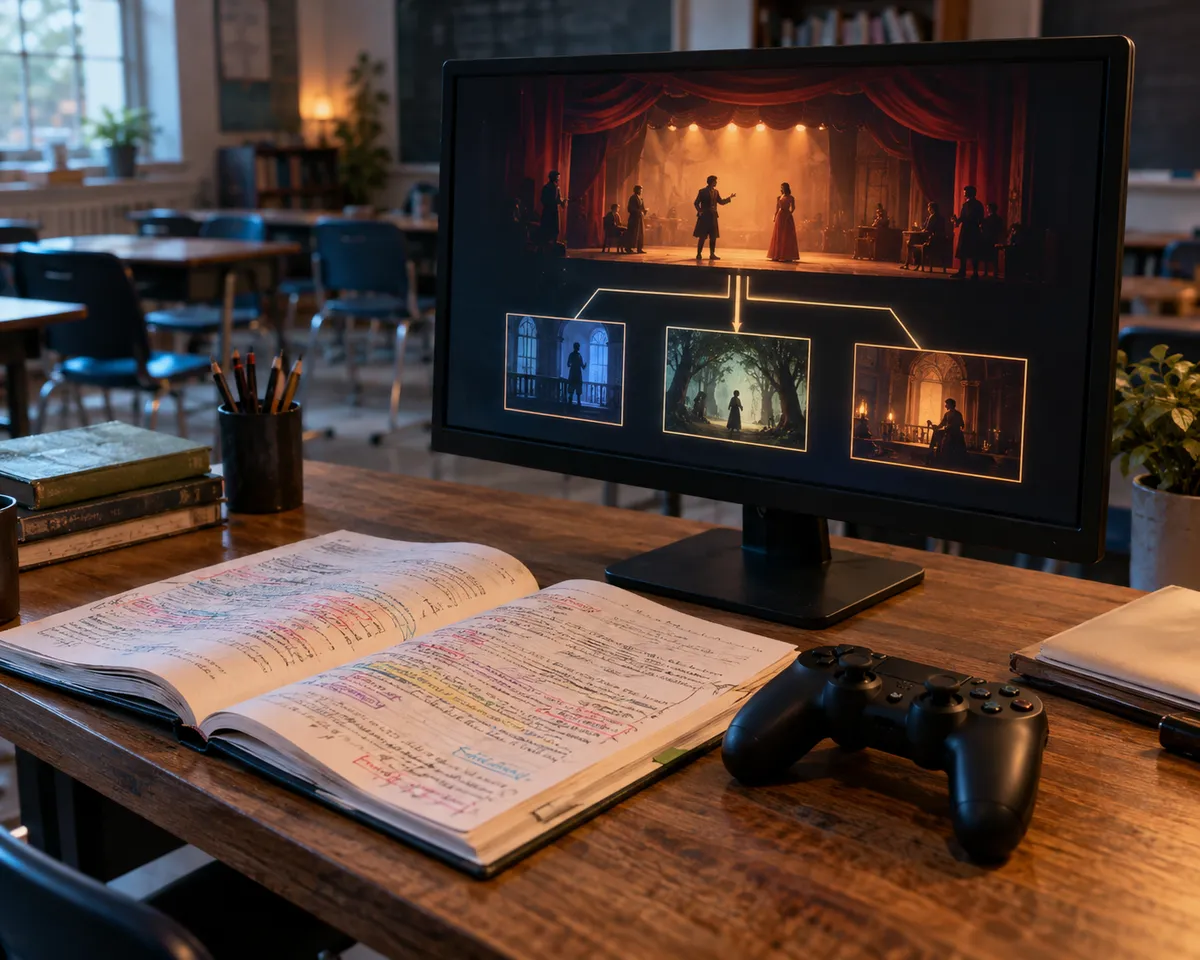
Shakespeare and video games sound like an odd pairing, but a UK research project now has £590,000 to find out whether they work together in the classroom. Aston University and the University of Birmingham have secured the funding for The Shakespeare Arcade, per ETIH EdTech News, which reported the story. By the end of this piece you will know what the project plans to do, what teachers could get out of it, and why the idea is worth taking seriously.
What The Shakespeare Arcade Will Actually Do
According to ETIH, the project will study how Shakespeare-inspired video games can support teaching and learning in UK schools. The plan has three main parts:
- Map existing games. Researchers will catalogue games inspired by Shakespeare, so teachers are not left searching blindly.
- Test them in classrooms. The games will be trialled with real students to see how they support learning.
- Share the results freely. The team will create free lesson plans and an open-access platform, also called The Shakespeare Arcade.
That last point matters. A free platform means a teacher with no budget and no gaming background could still pick up a tested game and a ready-made lesson around it.
Why Now: Falling Interest in English Literature
Per the ETIH report, the project arrives as English Literature A-level enrolments decline and educators look for more engaging ways to teach classic texts. It also fits a wider push to treat games as serious tools for literacy, critical thinking and multimodal learning.
"Multimodal" is the key word. A game combines text, images, sound and choices. A student who struggles with the dense language of a Shakespeare play on the page may engage differently when they have to make decisions inside a story built from it. Whether that actually improves understanding is exactly what the classroom trials are meant to answer.
Games as Tools, Not Just Adaptations
There is a difference between a game that retells a play and a game a teacher can build a lesson around. Our take: the interesting part of this project is the second category. A faithful adaptation might be fun, but a classroom tool needs to prompt discussion, such as why a character acts as they do or how a choice changes a scene.
The researchers have not, in the reporting we have seen, named which games will be tested, so we will not guess. That mapping stage should reveal how many Shakespeare-inspired games already exist and how different they are from one another.
What Teachers and Players Can Do Now
You do not have to wait for the results to start thinking along these lines.
- Look at games you already play. Does any use classic literature, poetry or theatre as a backbone? Note how it handles language.
- Ask a practical question. What would a student need to discuss after playing for 20 minutes? Good classroom games leave something to talk about.
- Watch for the open-access platform. When The Shakespeare Arcade launches, it should be the place to find tested games and free lesson plans.
The Honest Caveats
This is a research project, not a proven method. The funding pays for testing, and the outcome could be mixed. Games might help some students and distract others, and the findings may show which designs work and which do not. That is a useful result either way.
For gamers, it is a small but welcome sign that games are being studied as a serious medium for learning. Keep an eye out for the platform's launch, and if you teach, be ready to try a Shakespeare game with a class.