
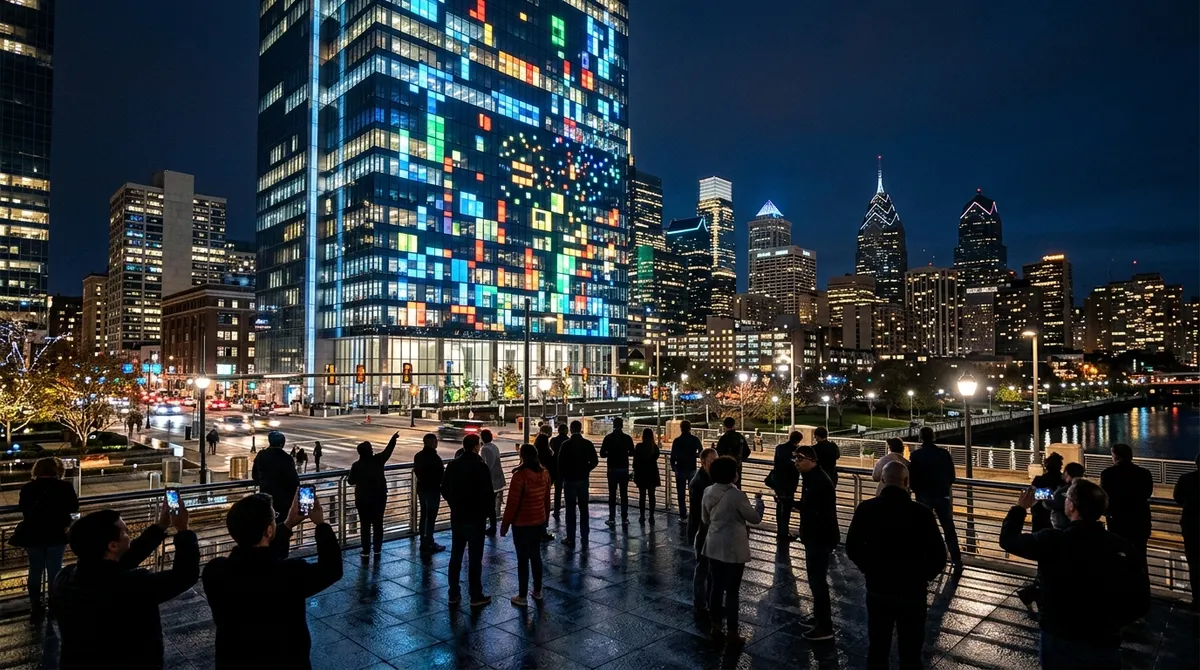
Philadelphia has long treated architecture as part of its public identity, but few projects have blurred the line between skyline and screen like Drexel University professor Frank Lee's work with the Cira Centre. By turning a glass office tower near 30th Street Station into a playable display, Lee helped show how game design, urban technology and civic imagination can meet in full public view.
How a Philadelphia skyscraper became a game display
The Cira Centre is one of University City's most recognizable buildings. Its sharply angled glass exterior sits beside Amtrak's 30th Street Station, making it visible to commuters, students, visitors and thousands of Center City residents. The tower also contains a programmable lighting system, with LED fixtures arranged across its facade.
For many buildings, decorative lights are only a branding tool. Lee saw something different. As a game designer and educator at Drexel, he recognized that the tower's illuminated grid could function like a massive, low-resolution display. That simple insight turned the building from a static landmark into an interactive platform.
The concept required more than creative enthusiasm. A skyscraper is not a traditional monitor. Each light behaves like a pixel, but the spacing, brightness, viewing distance and building shape all affect how an image appears. The team needed to design around architectural limits while preserving the feel of classic gameplay.
Frank Lee's role in urban game design
Frank Lee is widely known at Drexel for pushing games beyond conventional screens. His work connects digital media, public participation and playful learning. Rather than treating games only as entertainment products, he explores them as shared experiences that can change how people use public space.
That philosophy made the Cira Centre project especially powerful. A video game played on a skyscraper cannot be private. It becomes a city event. People look up, gather, react and talk to strangers. The scale transforms familiar mechanics into something communal.
Lee's background in game design helped guide the project from novelty toward meaningful engagement. The team had to select games that could work across the building grid. Fast, detailed graphics would fail at that size. Clear shapes, bold movement and instantly understandable rules mattered most.
Classic games at monumental scale
The Cira Centre became famous for hosting giant versions of simple arcade-style games. The appeal came from the contrast. Games once played on small televisions or handheld devices suddenly stretched across an office tower. The city itself became part of the interface.
Projects associated with Lee and Drexel included large-scale versions of familiar classics such as Pong and Tetris. These games were ideal choices because their visual language is easy to read. A paddle, a moving dot, falling blocks and completed lines all remain recognizable even from blocks away.
The Tetris project drew particular attention because it used the building's vertical form so naturally. Falling pieces suited the tall facade, while the tower's illuminated windows created a grid-like canvas. The result felt both nostalgic and futuristic.
These installations also attracted recognition beyond Philadelphia. The work helped place Drexel in conversations about interactive architecture, public media and record-setting digital displays. More importantly, it gave residents a memorable example of technology serving public fun.
Why the Cira Centre was the right canvas
The location mattered as much as the technology. The Cira Centre stands at a gateway between University City and Center City. It sits near major transit, civic institutions, campuses, offices and residential neighborhoods. That visibility made it a natural stage for a public digital experiment.
Unlike a festival screen that appears for one weekend, the building already belonged to the skyline. People recognized it. When its lighting system became interactive, the shift felt dramatic. A familiar structure suddenly behaved in an unexpected way.
The surrounding area also supported public viewing. Crowds could gather at nearby vantage points, while commuters could catch glimpses from trains, sidewalks and streets. The project did not ask people to enter a gallery. It met them in the city.
The technical challenge behind the spectacle
Turning a skyscraper into a playable game involves major design constraints. The team needed to translate game logic into lighting commands. They also had to control timing, input and visual feedback in a format that players could understand from a great distance.
Latency was one concern. If a player moves a control and the building responds too slowly, the game feels broken. Visibility was another. A shape that looks clear on a computer may blur or disappear across a facade. Designers needed to test how light behaved on glass, at night and from different viewing angles.
Scale changes everything. A single move in a small game becomes a public gesture on a tower. That creates excitement, but it also raises pressure. The experience must remain simple enough for spectators to follow, even if they are not playing.
The project also depended on collaboration. Drexel's creative and technical teams worked within the realities of building operations, lighting systems and urban safety. Public-facing innovation often succeeds only when designers, property owners and institutions coordinate closely.
What the project means for Drexel University
For Drexel, the Cira Centre games offered a strong example of experiential learning. Students and faculty could connect theory with a real civic platform. The work touched game design, computer science, digital media, architecture, event production and human-centered design.
It also reflected Drexel's location. The university is deeply tied to Philadelphia's innovation corridor. A project like this could not be separated from place. It used local infrastructure, local audiences and a local landmark to demonstrate creative technology at urban scale.
For prospective students interested in game design, the project remains a compelling case study. It shows that games can live outside consoles, phones and computers. They can shape events, activate buildings and bring communities together.
A public lesson in play and connection
The most lasting impact may be social. Cities often use digital displays for advertising or information. Lee's work suggested another possibility. Public screens can invite participation, surprise and collective joy.
When people watch a game on a skyscraper, they share an experience that is both digital and physical. They are not isolated behind devices. They are standing together, looking up at the same moving image. That shared attention is rare in modern urban life.
The project also challenged assumptions about play. Games are sometimes dismissed as distractions. On the Cira Centre, play became a way to reconsider architecture, technology and public space. It encouraged people to see the skyline as something dynamic rather than fixed.
Conclusion: a landmark moment for interactive cities
Frank Lee's Cira Centre projects remain important because they expanded what a game can be. They used Philadelphia's skyline as a creative medium and turned a building into a shared digital playground. The result was more than a technical demonstration. It was a vision of how cities can become more interactive, welcoming and imaginative.
As urban technology continues to evolve, projects like this offer a useful model. The best innovations do not only add screens to buildings. They create experiences that people remember. In University City, Drexel's skyscraper-scale game design showed that play can become part of the architecture of civic life.